

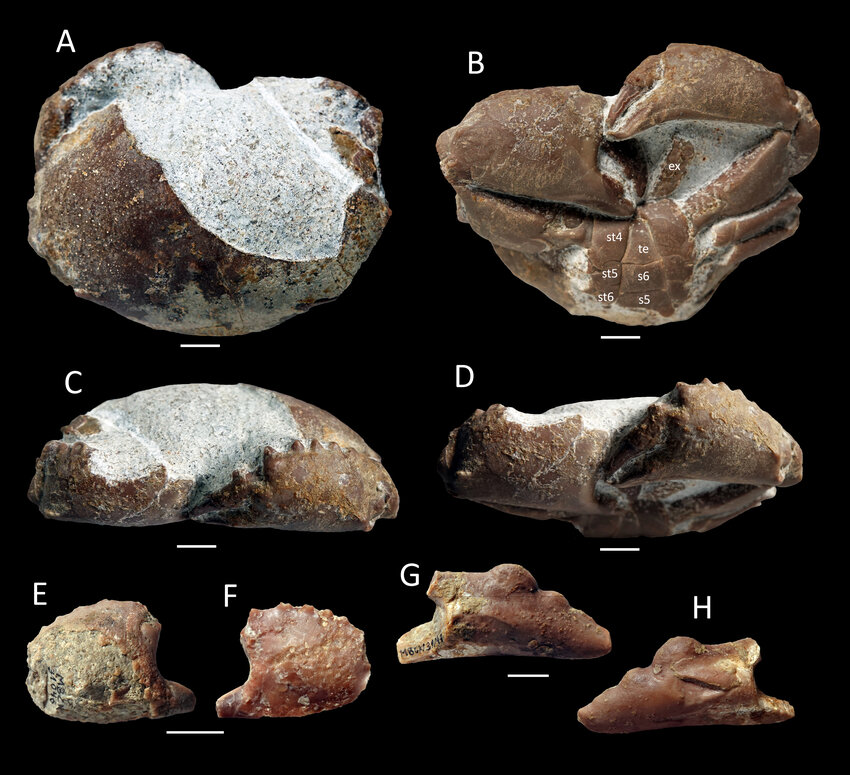
The find, located in Randa (Algaida), is also the first record of a crab of this age in the Balearic Islands
Mallorca continues to reveal unknown chapters of its distant past. A team of researchers associated with the Balearic Museum of Natural Sciences has identified fossil remains in Randa (Algaida) belonging to a marine crab that lived around 35 million years ago and had never before been documented in the Iberian Peninsula.
The discovery, recently published in the Bolletí de la Societat d’Història Natural de les Balears, also represents the first record of a crustacean of this age in the Balearic Islands.
The study was carried out by researchers Àlex Ossó, Josep Juárez-Ruiz and Rafel Matamales-Andreu, the latter two affiliated with MUCBO | Balearic Museum of Natural Sciences. The fossils belong to Palaeocarpilius cf. macrochelus, an extinct species that inhabited shallow tropical waters.
“Each new discovery helps us better understand what the Balearic Islands were like before the present-day islands existed and which organisms lived there. There is still much to discover, and Mallorca’s fossil sites continue to provide findings of great scientific interest,” the researchers explain.
When Mallorca was a tropical sea
Thirty-five million years ago, Mallorca’s landscape looked nothing like it does today. The Balearic Islands did not yet exist in their present form, and part of this territory was covered by warm waters that formed part of a vast tropical ocean, a precursor of the modern Mediterranean. Corals, mollusks, sea urchins, and numerous crustacean species thrived in this environment. The newly discovered crab was part of this vanished ecosystem. It was a robust animal with a broad, rounded carapace and large claws, one larger than the other, which it probably used to handle and break apart its food.
Another piece in reconstructing the history of the Mediterranean
Although other members of this crab group had already been identified in Catalonia, Aragon, and southeastern Iberia, the genus Palaeocarpilius had never before been documented in this region.
The discovery strengthens the idea that, millions of years ago, Mallorca shared a marine fauna very similar to that found along the coasts of present-day northern Italy. This connection helps scientists reconstruct the movements and relationships among marine ecosystems of the ancient Tethys Sea.
The value of scientific collections
The research also highlights the importance of the collections held by the Balearic Museum of Natural Sciences and the scientific work carried out there. The main specimen studied was donated to the museum by Joan Capellà Galmés, a contribution that demonstrates the important role that citizen collaboration can play in preserving and expanding knowledge of the Balearic Islands’ natural heritage.
The researchers point out that this discovery is probably only a small part of what remains to be uncovered. Mallorca’s geological outcrops continue to conceal valuable information about ecosystems that existed long before the emergence of the present-day islands.
Scientific article:
