

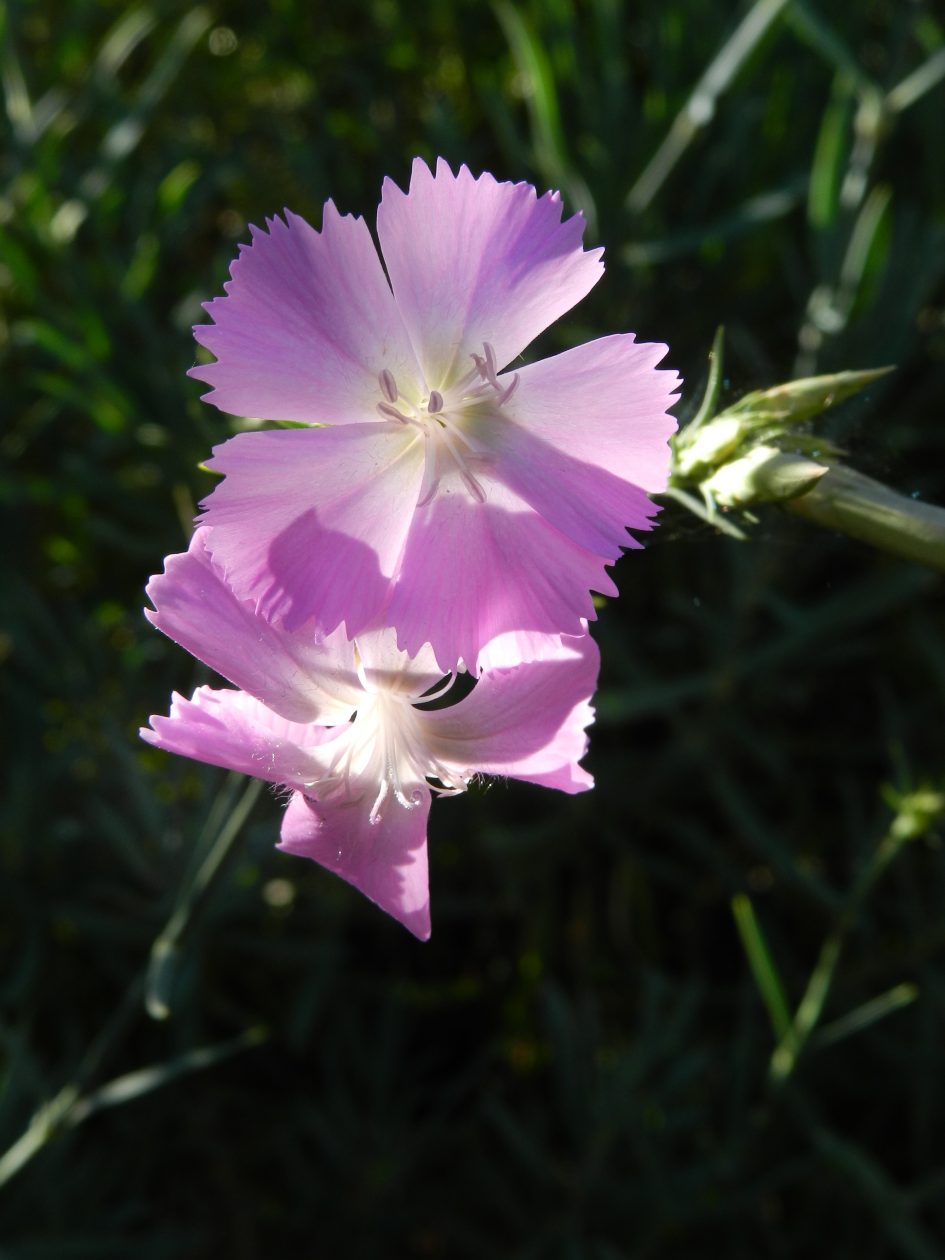
Dianthus rupicola subsp. bocchoriana L.Llorens & Gradaille
ENG: Formentor carnation
CAT: Clavell de Formentor
ES: Clavel de Formentor
FAMILY: Caryophyllaceae
DISTRIBUTION: Mallorca
DESCRIPTION: A small rupicolous shrub or subshrub with woody branches and evergreen, lanceolate, somewhat fleshy leaves. The flowers are pink with toothed petals. The inflorescence may bear numerous flowers that open sequentially throughout a long flowering period.
The Dianthus rupicola group is a Mediterranean complex comprising several subspecies:
- rupicola: northern Sicily and southern Italy.
- aeolicus: Aeolian Islands and northeastern Sicily.
- hermaeensis: northeastern Tunisia.
- lopadusanus: Lampedusa Island.
- bocchoriana: the Mallorcan lineage of the complex, distinguished by its glaucous, leathery leaves and several floral size and proportion characteristics.
The distinctiveness of subsp. bocchoriana has been further supported by recent morphometric and molecular studies, which demonstrate the genetic uniqueness of the Mallorcan population within the Mediterranean Dianthus rupicola complex. Despite this differentiation, current studies consider it more appropriate to maintain its subspecific rank, as originally proposed by Gradaille and Llorens in 1991.
CONSERVATION STATUS: Legally protected under the Habitats Directive, the Bern Convention, and the Balearic Catalogue of Threatened Species.
PHENOLOGY: Flowers from June to October.
LIFE FORM: Chamaephyte.
HABITAT: Grows on the maritime cliffs of the Formentor Peninsula, inhabiting rock crevices and small ledges exposed to wind and salt spray.
USES: Ornamental. This species is adapted to extreme environmental conditions, including summer drought, limited soil availability, intense sunlight, and marine aerosols.
AT THE BOTANICAL GARDEN: It was one of the first plants incorporated into the Botanical Garden’s collections. It is preserved both as a living plant in Terrace 2, dedicated to rocky coastal flora, and as seeds in the germplasm bank. The most recent collections were carried out in 2025. Samples of the other Mediterranean subspecies are also maintained, as Gradaille and Llorens described the Mallorcan subspecies in 1990 using comparative morphological studies based on plants cultivated in the Garden. The remaining subspecies are grown in Terraces 8 and 9, dedicated to the flora of other Mediterranean islands.
