

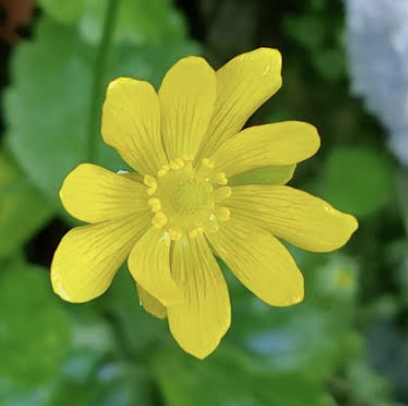
CAT: botón d’or, botor de tardor
ES: botón de oro
FAMILY: Ranunculaceae
DISTRIBUTION: Central and western Mediterranean, extending eastwards to the Aegean Islands. In the Balearic Islands, it is a very rare plant, present only in Mallorca, at a single locality spread between Es Coll d’en Rebassa and S’Aranjassa.
DESCRIPTION: Ranunculus bullatus is a small perennial herbaceous plant that remains practically unnoticed for much of the year, as its tuberous roots allow it to survive underground during unfavourable periods. In autumn, it regrows with a rosette of oval-shaped basal leaves, with slightly toothed margins and a somewhat swollen or wrinkled surface. The undersides of the leaves are hairy.
The flowers are solitary, bright yellow and approximately 2–2.5 cm in diameter. They grow on slender, upright, hairy stalks that can reach up to 20 cm in height. Each flower has numerous stamens in the centre and several yellow petals that stand out particularly against the low-growing autumn vegetation.
It is a particularly interesting species because, unlike many other buttercups that flower in spring, this one flowers mainly in autumn, after the first rains.
CONSERVATION STATUS: Critically Endangered (CR) in the Balearic Islands. The main threats are urban development, the construction of roads and other infrastructure, habitat fragmentation and loss, and the spread of ruderal and invasive plants.
A particularly concerning aspect is that it grows in a heavily transformed environment, between Palma Airport and the nearby urban areas.
PHENOLOGY: It flowers and produces its vegetative growth from October to December. In summer, it remains dormant thanks to its underground tuberous structures. It is highly dependent on rainfall. Under drought conditions, it can become very scarce.
LIFE FORM: geophyte
HABITAT: It grows in low, open grasslands, often among Mediterranean scrub, in places where a little soil accumulates and some moisture is retained after rainfall.
In Mallorca, its habitat is very distinctive: small grasslands on sandy soils with relatively high soil moisture, located practically at sea level, between 2 and 5 metres above sea level.
It is not a plant of permanently wet areas, but rather depends on the temporary availability of water in the soil. Its vegetative development and flowering are strongly influenced by the first autumn rains. This dependence on rainfall explains why it can remain practically unnoticed in dry years.
USES: No significant agricultural, food-related or ornamental uses of this species are known.
Historically, some folk medicine sources have mentioned it as a medicinal plant, attributing anti-inflammatory and antirheumatic properties to it. In the past, it was also believed to have properties related to female fertility, but these are traditional beliefs with no proven scientific basis.
It should be borne in mind that plants in the Ranunculaceae family contain irritating compounds, and some species can be toxic if ingested or applied to the skin. Therefore, this is not a plant that should be used for homemade medicinal purposes.
AT THE BOTANICAL GARDEN: Ranunculus bullatus is a very illustrative example of the fragility of Balearic flora. It is neither an endemic species nor one that is particularly rare across the Mediterranean region, but its Mallorcan populations are in a critical conservation situation.
Its presence in Mallorca reminds us that biodiversity is not conserved solely by protecting species exclusive to the islands, but also by preserving local populations of more widely distributed species that may disappear from our territory. This is also the role of the Sóller Botanical Garden, which has preserved this species as an autumn treasure since its beginnings.
At the Botanical Garden, we conserve seeds from natural populations in the germplasm bank, as well as herbarium specimens, both in the HJBS collection and in the HJBS-BONAFÈ collection.
