

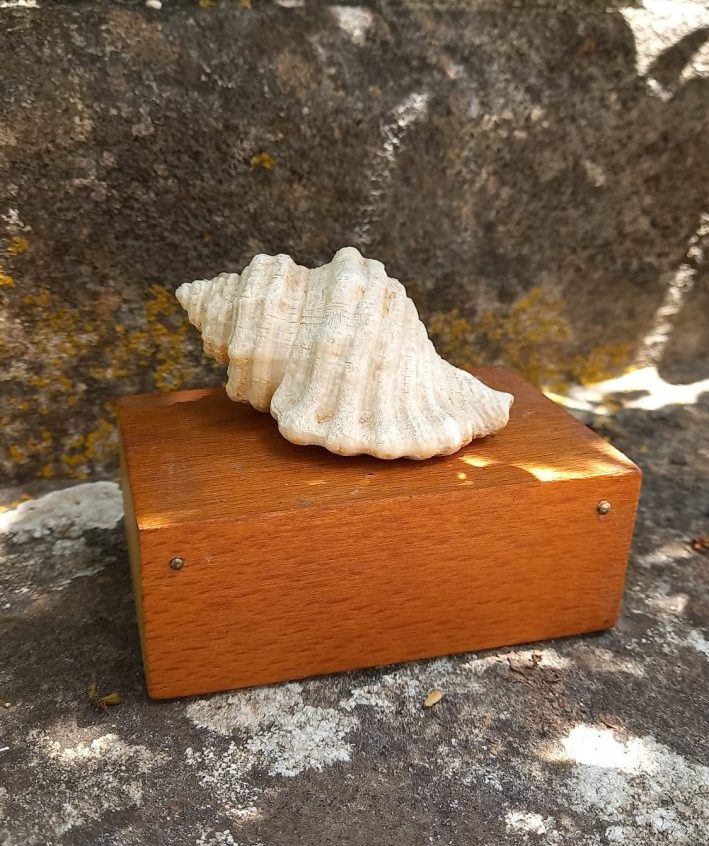
The corn pelut or hairy triton (Monoplex parthenopeus – MBCN33628) is a marine snail that currently inhabits most seas and oceans worldwide, living on rocky seabeds at depths of up to 70 m, and can exceed 15 cm in size. It is characterized by a shell ornamented with pronounced spiral cords and tubercles, typically orange and brown in colour. However, this colour is usually not visible, as the shell is often covered by an organic periostracum that forms long brownish “hairs”, giving the species its common name.
The specimen of the month comes from the Camp de Tir-Carnatge paleontological site, currently protected. This is an exceptionally rich site in fossils from the last interglacial period, around 130,000–123,000 years ago, representing an ancient beach. At that time, sea levels were higher than today and the climate was warmer, allowing the development of a marine mollusc community similar to that of present-day Senegal, with many warm-water species.
Origin: Palma, Mallorca.
Age: Cenozoic, Quaternary, Upper Pleistocene, MIS5e.
