

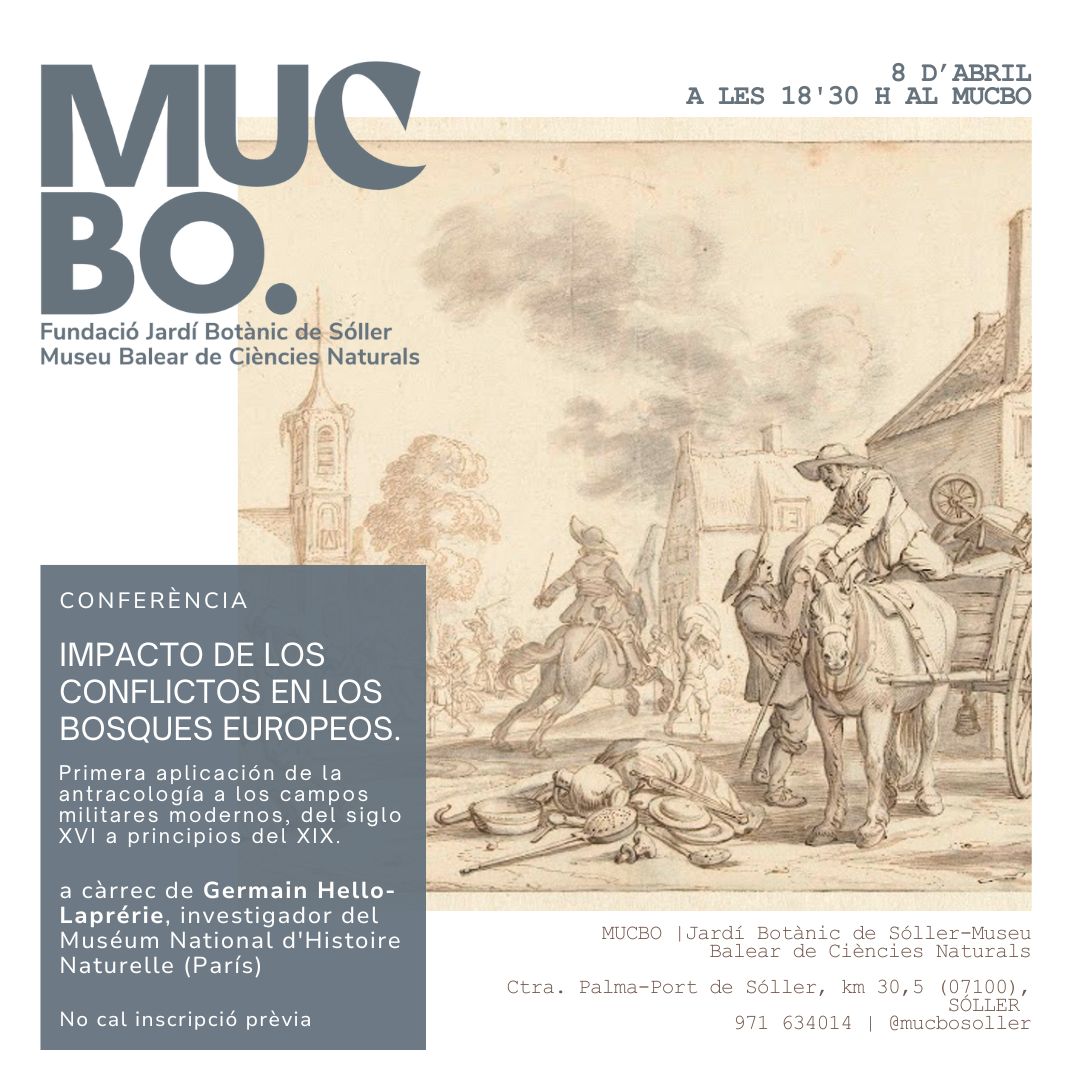
Don’t miss this fascinating conference on the impact of military conflicts on European forests!
On April 8, MUCBO will host Germain Hello-Laprérie, a researcher from the Muséum national d’histoire naturelle (Paris, France) and the University of Ghent (Belgium), who will present the results of his groundbreaking research on the impact of early modern conflicts (from the 16th to the 19th century) on the forests of Northwestern Europe.
In this conference, Germain will discuss his doctoral thesis, which focuses on how armies of the time managed natural resources, particularly firewood, during conflicts. Through the analysis of over 24,000 charcoal fragments from cooking stoves in military camps, it has been identified how troops used nearby forest resources and how these practices contributed to the degradation of forest ecosystems. This research also highlights the complementarity between archaeological studies and historical sources, offering a new perspective on the interaction between war, natural resources, and the environment.
Key points of the conference:
- Analysis of charcoal from military camps in Belgium, the Netherlands, Luxembourg, and northeastern France.
- The impact of military occupations on forest landscapes and ecosystems.
- The role of anthracology in understanding the ecological effects of conflicts.
- The connection between archaeological research and historical sources to reconstruct the past.
The conference will be an excellent opportunity to learn more about how historical conflicts have left marks on our natural environment and how modern science can help us understand these impacts.
We look forward to seeing you for an interesting day of learning and reflection on history, the environment, and archaeology!
