

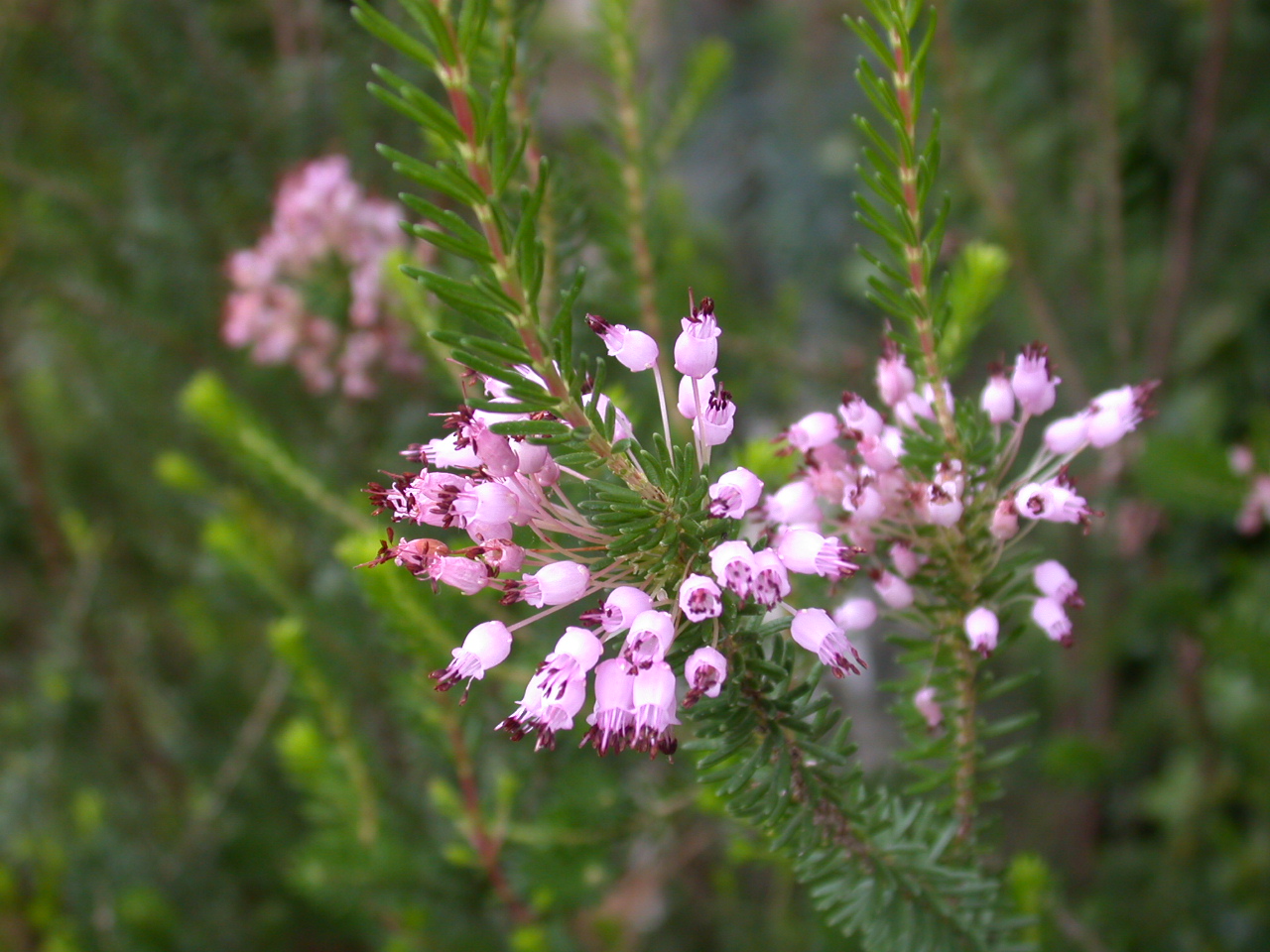
Erica multiflora L.
CAT: xiprell, ciprell, mata de tronets (Valencia), bruc d’hivern (Catalonia)
ES: brezo, pedorrera, petorra
FAMILY: Ericaceae
SYNONYMS: white varieties have been described, as well as others with denser or more compact flowers, but all are considered part of the same species.
DISTRIBUTION: Western Mediterranean. In the Balearic Islands, it is present on Mallorca, Menorca, Ibiza, Formentera and Cabrera, as well as on several islets, including Sa Dragonera.
DESCRIPTION: A perennial shrub, highly branched from the base, which can reach between 0.5 and 2 m in height, with upright stems and greyish bark. The leaves are small, linear and narrow, needle-like, with revolute margins, glabrous, and densely arranged along the branches. The flowers are hermaphroditic and grouped in dense terminal and axillary inflorescences at the ends of the stems. A distinctive feature is that the stamens protrude beyond the corolla. The corolla is pink or purple, although it can sometimes be paler or even whitish, and is shaped like an urn or an elongated bell. The fruit is a small, globose capsule protected by the persistent calyx.
CONSERVATION STATUS: there are no significant known threats and it is not listed as a protected species.
PHENOLOGY: it flowers mainly between September and January, with peak flowering occurring during autumn and early winter. Its spectacular flowering at a time when relatively few other species are in bloom makes it a very important source of nectar for numerous pollinating insects.
LIFE FORM: nanophanerophyte (shrub)
HABITAT: a typical shrub of open pine forests and Mediterranean scrubland on calcareous substrates, growing in dry, sunny environments from sea level to mid-altitude mountain areas. It is an indicator of calcareous or alkaline soils.
USES: this species is very well adapted to summer drought thanks to its small, leathery leaves, making it highly valued in Mediterranean gardening. It is also one of the most important nectar-producing plants of the Mediterranean autumn; its flowers provide nectar for bees, bumblebees and other insects throughout autumn and winter. It helps protect the soil in stony areas prone to erosion. Its dry branches were traditionally used to light fires. In fact, the Valencian common name “mata de tronets” and the Spanish names “petorra” and “pedorrera” probably refer to the crackling sounds made by the branches as they burn.
AT THE BOTANICAL GARDEN: you will find flowering plants on terrace 4, in the clearings of the holm oak woodland, and on terrace 3, in a sunny, open passage area. The germplasm bank preserves seeds from populations on all the islands, while the herbarium holds specimens representing both present-day populations and historical or extinct populations. The oldest herbarium specimen dates from 1898 and comes from Menorca.
Envieu els vostres comentaris sobre el BizChat
