

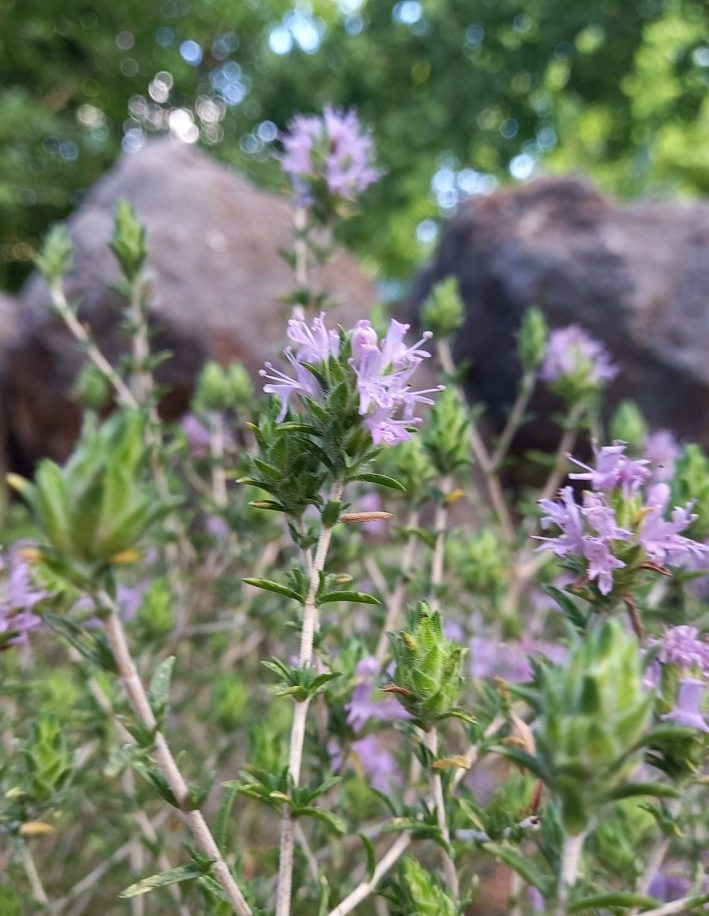
EN: conehead thyme, Mediterranean thyme
CAT: frígola de sant Joan, senyorida?
ES: tomillo, tomillo andaluz
FAMILY: Lamiaceae
DISTRIBUTION: Mediterranean region. In the Balearic Islands it is found in the southwest of Mallorca, Ibiza and Formentera.
DESCRIPTION: A woody shrub forming a more or less compact cushion-shaped mound, reaching no more than 40 cm in height. It bears pink to deep lilac flowers and small, highly aromatic leaves. It can be readily distinguished from common thyme (Thymus vulgaris), which is lower-growing and more delicate, with a more prostrate and open habit. The flowers of Thymbra capitata are grouped into dense flower heads, and its leaves are larger and more rigid. Its scent is also noticeably stronger.
CONSERVATION STATUS: LC (Least Concern).
PHENOLOGY: Flowers from May to October.
LIFE FORM: Chamaephyte.
HABITAT: A typical plant of Mediterranean maquis vegetation, aromatic shrublands (thyme scrub) and pine forests.
USES: Edible. It is used in both medicine and perfumery. Its essential oil has antimicrobial, antioxidant, antifungal and antiparasitic properties and acts as a disinfectant for the respiratory and digestive systems, among others. It should always be diluted in a carrier vegetable oil. Thymbra capitata is essentially a natural antibiotic that can be taken as an herbal infusion to help treat infections, especially those affecting the digestive and respiratory systems. An infusion can be prepared using one tablespoon of dried leaves and flowers per cup of water. The same infusion can also be used to wash wounds or as a gargle for mouth ulcers and canker sores.
Foto: Exemplar del Jardí Botànic, Herbari Virtual del Mediterrani Occidental – Universitat de les Illes Balears
